What happens when AI moves beyond supporting decisions and starts making them? This edition of our AI Event Series explored how AI agents could reshape financial services from autonomous operations and agentic commerce to governance, security and the evolving role of human creativity.
How AI Agents Will Rewrite Finance
Hosted on 1st July 2026
At our previous AI event, Building Real AI: From Foundation Models to Scalable Enterprise, the conversation focused on moving beyond experimentation and proving real business value from data quality and governance to enterprise adoption.
Our latest session, How AI Agents Will Rewrite Finance, took the discussion a step further.
What happens when AI evolves from a tool that supports decisions to an autonomous agent capable of making them?
From agentic commerce and autonomous financial operations to stablecoins, AI governance and the future role of humans in financial services, the evening explored how fundamentally finance could change over the next decade.
Moderated by Farshad Nowshadi, VC & Mentor (Level39) | Board Advisor to Major Banks, the panel brought together:
- Adizah Tejani – Venture Capital and Board Advisor
- Arnav Khare – Principal Technologist, Resilience AI at AWS
- Erkin Oksel – CEO and Founder, EyesClear
From building AI to AI acting autonomously
The conversation marked a clear shift from our previous event.
In February, the focus was on the practical challenges of implementing AI: moving beyond proofs of concept, improving data quality and establishing governance.
This time, the panel explored what happens once those foundations are in place, and AI begins operating with increasing autonomy.
As Amy French, Director of Level39, noted in her opening remarks, organisations are already seeing AI evolve from systems that support decision-making into systems capable of executing workflows, taking action and continuously learning.
The question is no longer whether AI will transform financial services, but how quickly that transformation will happen.
AI agents and the future of finance
Farshad opened with a bold prediction: AI agents could automate large parts of middle- and back-office operations, from onboarding and customer service to compliance and fund administration.
The panel agreed that automation is coming, but its impact will vary.
Arnav argued that repetitive tasks are likely to be increasingly automated, while complex decisions, edge cases and customer interactions will continue to require human expertise.
Adizah highlighted the different starting points of legacy banks, challengers and global institutions, with technology architecture, engineering capability and leadership all influencing the pace of change.
Erkin pointed to the importance of context, noting that financial services involve complex political and regulatory considerations that technology alone cannot replace.
The consensus was clear: AI will reshape roles and automate significant operational work, but human judgement will remain essential where risk and complexity are involved.
Agentic commerce and the future of money
The future of payments sparked some of the evening’s most animated discussion.
Farshad outlined a vision of an increasingly autonomous economy, where AI agents transact directly with one another using stablecoins, blockchain infrastructure and machine-to-machine payment protocols.
The panel recognised the potential, while questioning how quickly this future could arrive.
- Arnav highlighted the potential for new payment models to support micro-transactions and agent-to-agent commerce.
- Adizah pointed to the complexity of global B2B payments, where regulation, trust and jurisdictional requirements remain significant barriers.
- Erkin argued that some of the biggest challenges facing global finance are political rather than technical.
The takeaway: The technology is advancing quickly, but the systems around it are complex meaning widespread adoption may take longer than some predict.
Can incumbents keep up?
The panel also debated whether established financial institutions can compete with more agile, AI-native challengers.
The answer wasn’t necessarily about size or access to technology.
Arnav argued that many banks already have highly capable innovators. The bigger challenge is creating the culture and processes needed to bring ideas into production.
Adizah questioned whether acquisitions are always the answer, suggesting partnerships could prove more valuable and sustainable.
Erkin added that, as AI becomes more accessible, many institutions are increasingly choosing to build solutions internally.
The discussion reinforced a theme that emerged across both AI events: Technology alone is rarely the differentiator. Culture, execution and adaptability matter just as much.
Governance, security and responsible AI
Governance quickly emerged as another major theme, with the discussion highlighting the need for:
- Closer collaboration between technologists, policymakers and regulators.
- Governance built directly into AI development through testing, evaluation and guardrails.
- Greater focus on adversarial AI and cybersecurity threats.
- Regulation that can keep pace with rapidly evolving technology.
An audience member working in counterterrorism reinforced that these aren’t distant concerns – governments are already actively addressing them.
Responsible AI isn’t a future concern. It’s a present-day necessity.
Why human creativity still matters
The evening ended on a more optimistic note.
An audience question raised concerns about AI creating new forms of “gatekeeping”, particularly if automation removes some of the entry-level tasks through which people traditionally gain experience.
The panel’s response was that while AI may automate routine work, genuinely original thinking remains difficult to replicate.
Adizah argued that creativity remains fundamentally human, while Erkin pointed to Bohemian Rhapsody as an example of an unexpected creative breakthrough that cannot simply be extrapolated from past data.
Asked what advice they would give future generations, the panellists highlighted:
- Multidisciplinary skills – Arnav Khare
- Curiosity and experimentation – Adizah Tejani
- Exploring opportunities beyond today’s knowledge – Erkin Oksel
- Creativity, imagination and entrepreneurship – Farshad Nowshadi
Key takeaways
- AI agents are moving from theory to reality, particularly across financial services and operational workflows.
- Automation will reshape jobs, but human judgement remains essential in complex and regulated environments.
- Agentic commerce could change how money moves, although adoption may take time.
- Incumbents can still compete, with culture, execution and adaptability potentially mattering more than size.
- Governance and security are now business priorities, not future considerations.
- Creativity and multidisciplinary thinking will become increasingly valuable in an AI-driven world.
Where the conversation goes next
If our previous event focused on building real AI, this session explored what happens when that AI begins acting on our behalf.
The debate wasn’t always unanimous and that was precisely what made it valuable. Across venture capital, cloud technology, fintech and regulation, there was broad agreement on the direction of travel, but healthy disagreement about the speed, scale and nature of the changes ahead.
One thing, however, was difficult to dispute: the conversation has evolved.
The industry is no longer asking whether AI will transform financial services.
The question now is how organisations prepare for a future where AI agents become active participants in the way financial systems operate.
As Level39’s AI event series continues, this discussion provided another step towards understanding that future and what it means for the builders, investors, financial institutions and innovators shaping it.

Fin|Tech|Bio: Sandbox to Scale
30th June 2026
Women at Level39 Network: Demystifying Investment Decisions
30th June 2026
Level39 Member Highlights: September Edition
30th June 2026
Inside Level39: August & September Edition
30th June 2026
Level39 Member Highlights: August Edition
30th June 2026
Inside Level39: July Edition
30th June 2026
Level39 Member Highlights: July Edition
30th June 2026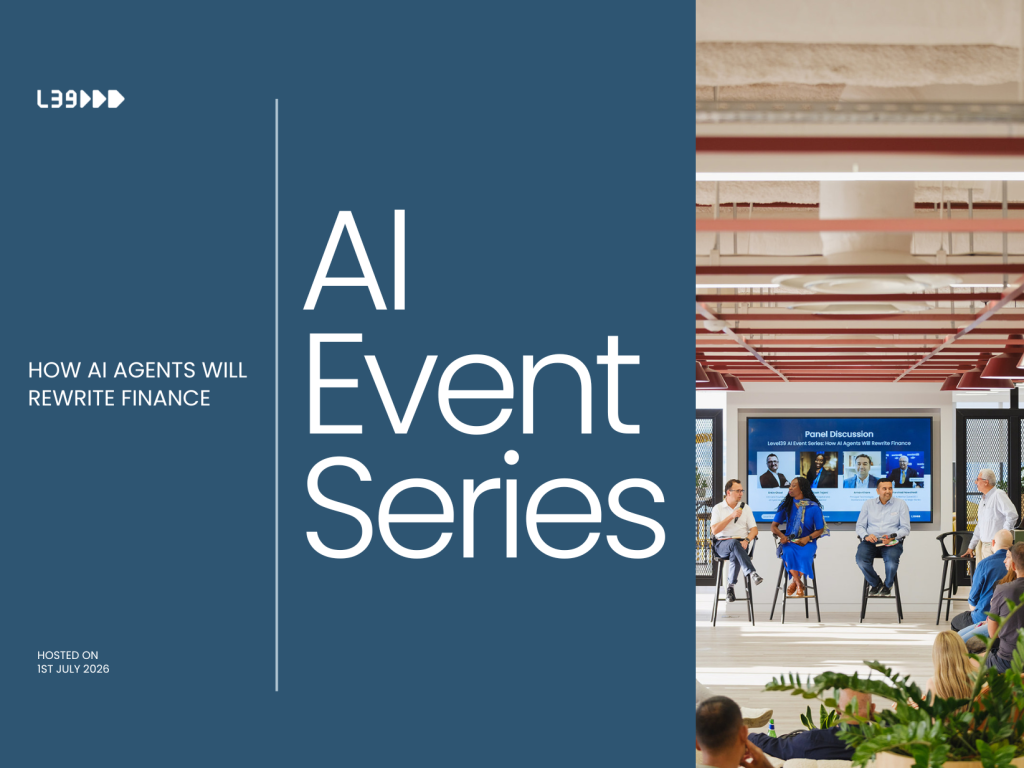
How AI Agents Will Rewrite Finance
30th June 2026
Inside Level39: June Edition
30th June 2026