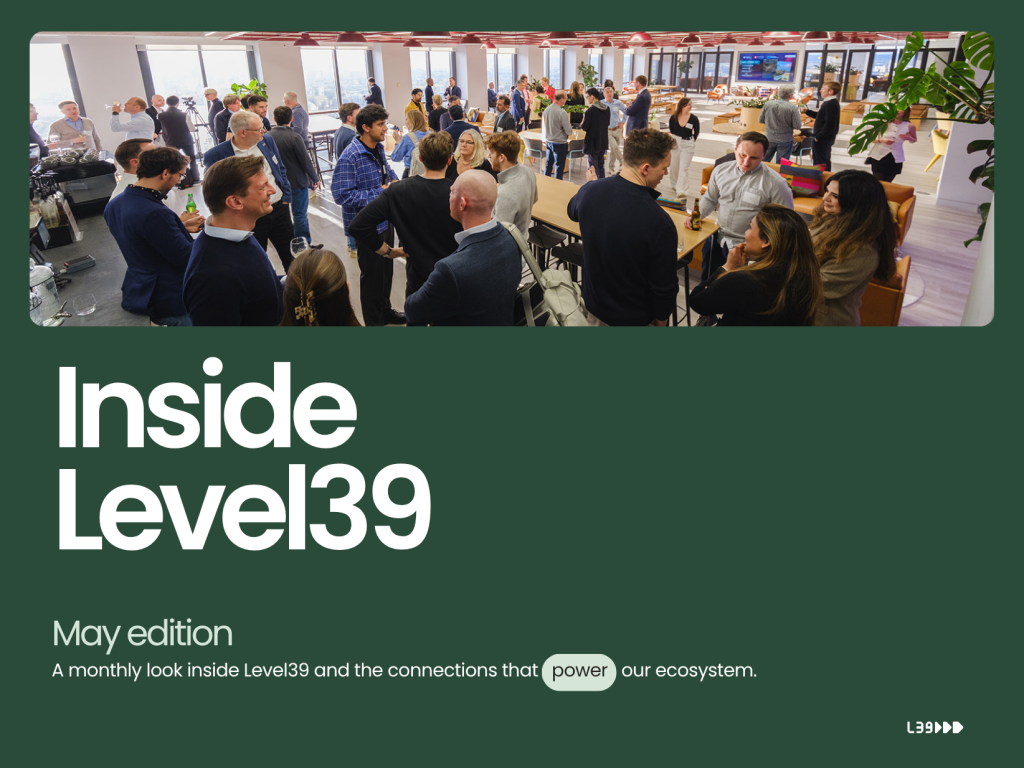
Moving AI beyond the sandbox takes more than the right technology. Our latest Fin|Tech|Bio explored the people, processes and guardrails needed to turn experimentation into real-world impact.
Fin|Tech|Bio: Sandbox to Scale
What It Really Takes to Move AI Beyond Experimentation
AI experimentation is everywhere. Moving from individual tools and promising pilots to technology that delivers meaningful value across an organisation is a very different challenge.
That question was at the heart of our latest Fin|Tech|Bio: Sandbox to Scale session at Level39, delivered in partnership with CWG Life Sciences, bringing together perspectives from technology, healthcare, life sciences, financial services and legal innovation.
The Fin|Tech|Bio series was created to connect our fintech community with healthtech, life sciences and the wider innovation ecosystem, opening up opportunities for cross-sector learning and collaboration. As Amy French, Director at Level39, shared in her welcome, some of the most impactful conversations emerge when these sectors come together to tackle shared challenges.
Moderated by Elliott Young of Dell Technologies, the panel brought together:
- Jasper Clouting, Head of AI & Offering Strategy at IQVIA UK
- Adama Ibrahim, Founder & President of Crest Meridian Limited
- Akber Datoo, Founder & CEO of D2 Legal Technology
Together, they explored a deceptively simple question: what does it really take to move AI from sandbox to scale?
Start with the problem, not the AI
One theme came through quickly: simply giving people access to AI does not make an organisation AI-enabled. Jasper pointed the discussion pointed to three priorities:
Define the problem first: productivity gains do not follow automatically from deploying an enterprise AI solution. Adoption needs clear objectives and change management.
Design AI around the work: break processes down, identify the highest-value opportunities and incorporate technology around business objectives, rather than adding another generic tool.
Choose the right approach: combine technical capability with domain expertise, then use generative AI, automation or deterministic analytics according to the task.
The message was clear: scale starts with knowing what you’re trying to improve.
Think smaller before thinking bigger
While AI conversations can quickly turn towards ambitious transformation programmes, Elliott challenged the idea that organisations should immediately focus on “moonshot” applications.
Instead, some of the greatest value may sit within the smaller, repeatable tasks happening every day. Automating administrative or routine work might not generate the biggest headline but repeated at scale it can represent a meaningful proportion of an organisation’s processes.
Jasper gave a life sciences example: rather than pharmaceutical representatives spending time recording notes and completing administrative tasks, AI can support those activities so they can concentrate on higher-value interactions.
Adama took the idea further, describing a future in which people and AI work seamlessly alongside one another, with technology taking care of lower-value activity and leaving humans to focus on work that is intellectually meaningful and valuable.
Scaling responsibly means understanding the risk
For heavily regulated industries, scaling responsibly means recognising that applications carry different levels of risk. The panel highlighted three principles:
- Apply proportionate governance: Adama argued that AI supporting a low-stakes decision with a clinician in control should not be treated like technology influencing diagnosis or treatment.
- Plan for unpredictable outputs: Akber noted that generative AI can produce different answers from the same input, creating challenges for sectors built around predictability and regulation.
- Keep people accountable: Akber also emphasised that AI-generated information must be checked, while explainability remains essential when organisations are responsible for the final decision.
AI transformation is still a people challenge
For all the discussion around models, data and infrastructure, when the panel was asked what capability they would prioritise for the future, Adama’s answer was surprisingly analogue: people. She highlighted the need for individuals who can bridge domain expertise and technology, with the curiosity to understand both the problem and the tools available to solve it.
The conversation highlighted three considerations for organisations building that capability:
- Be realistic about your starting point: understand your organisation’s readiness and choose between broader transformation or a more targeted approach.
- Build AI fluency: individuals also have a responsibility to develop their understanding of the technology.
- Protect human expertise: consider how AI can support development without removing the foundational learning needed to build genuine knowledge and judgement.
That final point raised an important question for the next generation entering the workforce. As AI accelerates what people can achieve, how do organisations ensure it is also developing future experts, rather than simply people who are good at using AI?
From experimentation to infrastructure
As AI becomes more embedded in organisations, the conversation inevitably moves beyond individual use cases towards infrastructure, ownership and resilience.
An audience question on AI sovereignty opened up a broader discussion around organisations’ dependence on external frontier models and what happens when AI begins supporting business-critical processes.
Elliott highlighted the operational risk of becoming heavily reliant on a provider for processes that an organisation can no longer easily perform without that technology, while Jasper pointed towards growing consideration of open-source models where a frontier model may not be necessary for every task.
It reinforces another lesson from the evening: scaling AI isn’t simply about finding the most powerful model. It’s about choosing the right technology for the right task and retaining enough flexibility to evolve as the landscape changes.
So, what does it take to move from sandbox to scale?
Across healthcare, life sciences, financial services and legal technology, the discussion surfaced several principles organisations can take forward:
- Lead with the business problem: don’t introduce AI simply because the technology is available.
- Look for repeatable value: smaller, high-frequency use cases can have meaningful impact when deployed at scale.
- Match the technology to the task: generative AI, automation and deterministic analytics each have different roles to play.
- Build around people: domain knowledge, technical fluency and curiosity remain central to successful transformation.
- Treat risk proportionately: governance should reflect the stakes of the application, particularly across regulated sectors.
- Keep humans accountable: AI can augment judgement, but explainability and human oversight become more important as its role grows.
- Think beyond the pilot: data, infrastructure, model choice, governance and sovereignty all become more important as AI moves into business-critical processes.
Scaling AI with purpose
Perhaps the biggest takeaway from the evening was that scaling AI is not a technology question in isolation. The tools and models will continue to evolve, but genuine value comes from how effectively organisations combine them with their people, processes, data and approach to risk.
That is particularly important across the industries represented through Fin|Tech|Bio, where innovation is moving quickly but trust, accountability and expertise cannot be an afterthought.
Bringing perspectives from finance, healthcare, life sciences, legal and technology into the same conversation creates an opportunity to share ideas and explore how approaches working in one sector could translate to another.

Fin|Tech|Bio: Sandbox to Scale
1st June 2026

Level39 Member Highlights: September Edition
1st June 2026
Level39 Member Highlights: August Edition
1st June 2026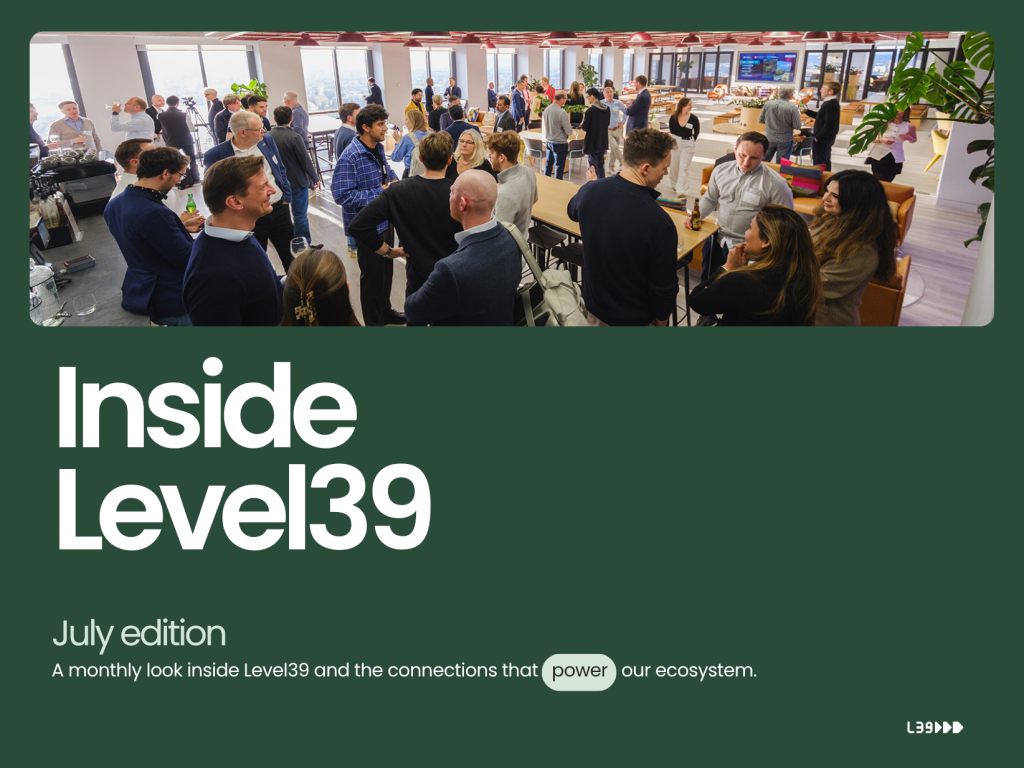
Inside Level39: July Edition
1st June 2026
Level39 Member Highlights: July Edition
1st June 2026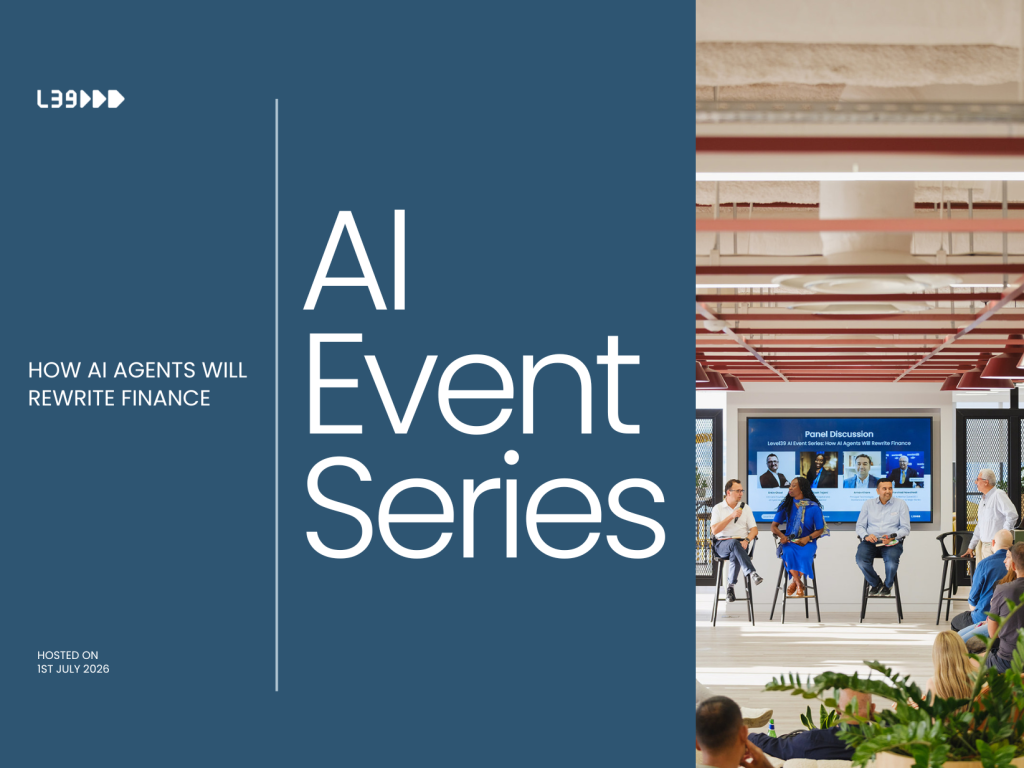
How AI Agents Will Rewrite Finance
1st June 2026
Inside Level39: June Edition
1st June 2026
Level39 Member Highlights: June Edition
1st June 2026