As AI becomes more embedded across businesses, how do we balance innovation with security, accountability and resilience? We explore the key insights from the final event in Level39’s 2026 AI Event Series.
Trusting AI: Building confidence in an increasingly autonomous future
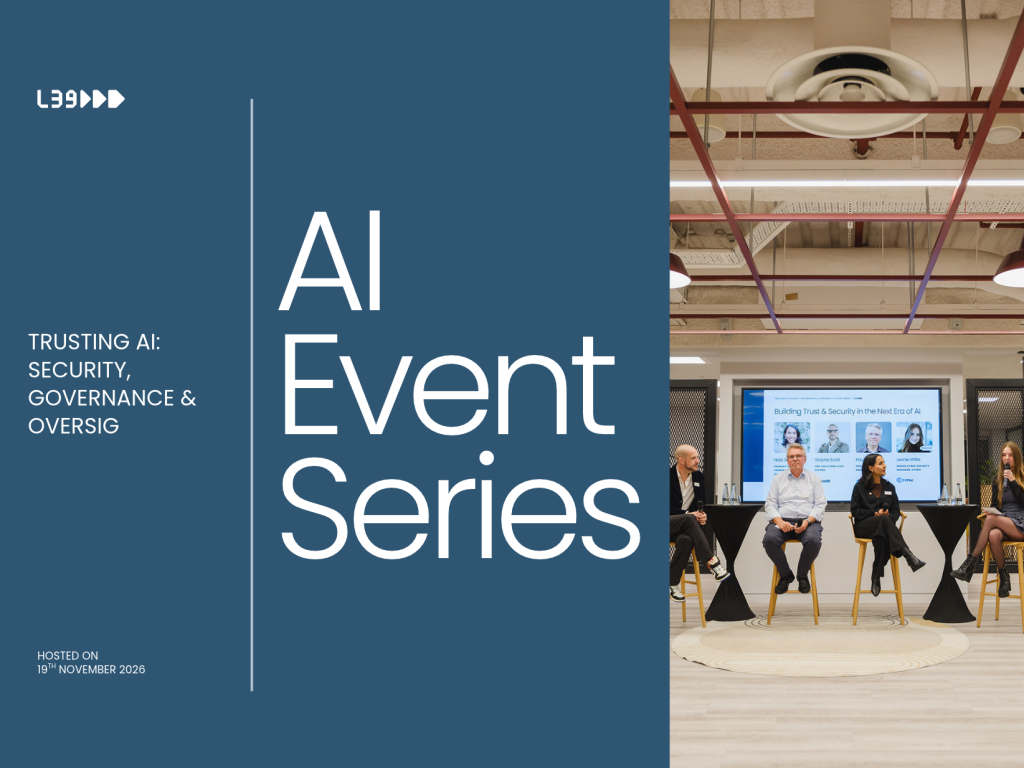
Last week, we brought our 2026 AI Event Series to a close at Level39 with Trusting AI: Security, Governance & Oversight, bringing together perspectives from banking, cyber security, operational resilience and regulatory technology.
Across the full series, we’ve followed AI’s progression from experimentation towards real-world application, exploring business value, scaling AI and the future of finance. For our final discussion, attention turned to what needs to underpin that progress and ultimately build trust in AI: security, accountability and resilience.
Moderated by Leonie Witte, Senior Cyber Security Manager of CyPro, the panel brought together Nida Sattar, Product Director – Transaction Banking at Allica Bank; Wayne Scott, GRC Solutions Lead at Escode; and Paul Taylor, Principal Advisor – Compliance & Communications Surveillance at Smarsh.
Can governance keep pace with AI?
An early theme was the speed of AI adoption and the challenge organisations face in ensuring governance keeps pace.
Nida argued that governance needs to become part of how AI is introduced and developed from the outset, while Paul raised the challenge of “shadow AI”, where employees independently adopt tools because of the productivity benefits they offer.
Wayne extended this to the wider technology supply chain, highlighting how AI may be embedded within third, fourth or fifth-party dependencies without organisations necessarily having full visibility.
Together, these perspectives raised an important question: as AI becomes more widespread, how can organisations establish greater trust in AI while still enabling innovation?
Starting with the problem, not the technology
Another clear message was that AI adoption should begin with a genuine customer or business need.
Drawing on her product experience at Allica Bank, Nida discussed the importance of understanding the problem first and applying a level of governance proportionate to the potential risk.
Key considerations included:
- Start with the customer or business problem, rather than finding a reason to introduce AI.
- Consider the consequences of an incorrect outcome and build safeguards accordingly.
- Apply governance proportionately, recognising that not every AI application carries the same level of risk.
Testing technology that doesn’t always give the same answer
The panel also explored a fundamental challenge with generative AI: how do you determine whether its outputs are reliably correct?
Paul discussed how generative models differ from traditional technology because the same input can produce different responses. He highlighted approaches where one large language model evaluates another’s output, creating an additional layer of quality control.
Nida shared a similar approach, using two models to validate outputs with human intervention where they disagreed.
Ultimately, what constitutes “good enough” accuracy depends on the application, who is affected and the consequences if the technology gets it wrong. Testing, transparency and appropriate human oversight are therefore important components in developing trust in AI.
Building security and resilience in from the start
Rather than treating security as a final stage of development, the discussion highlighted the importance of:
- Building security in early, including permissions, access controls, architecture and testing.
- Understanding the data involved, including what AI systems can access and where information may be shared.
- Retaining appropriate human oversight, particularly for higher-risk decisions and outputs.
- Understanding technology dependencies across models, platforms and infrastructure.
- Planning for failure and how the organisation would respond if a critical AI system became unavailable.
Leonie also shared practical lessons from CyPro’s own use of AI, including access controls, auditability, security reviews, data handling and human oversight.
What happens when the technology fails?
Wayne brought an operational-resilience perspective, challenging organisations to think beyond whether an AI system works to consider what happens when it doesn’t.
This includes understanding dependencies on model, cloud and infrastructure providers, and considering how easily critical technology could be replaced.
As AI becomes embedded in more business-critical processes, the question shifts from “How do we stop AI from failing?” to “How do we make sure failure doesn’t become harmful or systemic?”
The questions moving the conversation forward
Questions from the audience pushed the discussion into areas likely to become increasingly important as AI develops:
- What happens when AI systems and agents begin interacting with other AI systems?
- Are we building greater trust in AI, or simply becoming more comfortable with uncertainty?
- Where does accountability sit when an automated decision causes harm?
- What could automation mean for entry-level roles and future career pathways?
- How can investors, customers and partners determine whether an AI-dependent business is genuinely trustworthy?
Five takeaways from the discussion
While each speaker brought a different perspective, several principles came through:
- AI governance needs to evolve alongside adoption.
- AI should solve a genuine customer or business problem.
- Risk and oversight should be proportionate to the use case.
- Human accountability remains important, particularly around consequential decisions.
- Security, resilience and supplier dependencies should be considered from the outset.
Continuing the conversation in 2027
While this marked the final event in our 2026 AI Event Series, there is clearly much more to explore as AI and its applications continue to evolve.
We’re already planning our 2027 events programme and look forward to continuing the series next year, building on the conversations and perspectives shared by our community throughout 2026.
A huge thank you to Nida Sattar, Wayne Scott and Paul Taylor for sharing their expertise, and to Leonie Witte for guiding the conversation. We’d also like to thank everyone who joined us across the series so far and helped make each discussion such an engaging one.
More on our 2027 programme will be shared soon. Sign up to our monthly newsletter for updates direct to your inbox, or keep an eye on the Level39 website for upcoming events.